


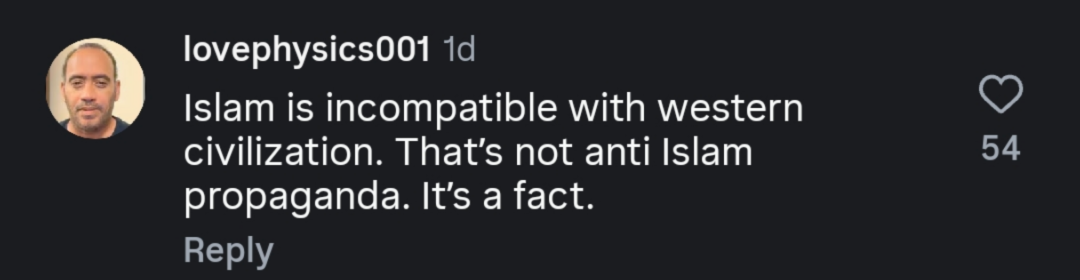
A bigot with the Instagram handle “lovephysics001” said, “Islam isn’t compatible with Western civilization. That’s not anti-Islam propaganda. It’s a fact.” I asked him, “Is Western civilisation humane?” He replied with a question of his own: “Is Islam humane?”
If you can’t even tell me whether Western civilisation is humane, and instead ask me rhetorically whether my religion is humane in some sort of “gotcha” moment, you’ve revealed that you cannot defend the West on its own merits and can only attack the Other (Said, 1978). The question of whether Islam is “compatible” with Western civilisation already places the West in the position of judge and Islam in the position of defendant. Western political categories are treated as universal, while Muslim political frameworks are treated as particular, suspicious, or in need of translation before they can even be recognised as coherent (wrzky, 2026b).
The statement also assumes religion exists to adapt itself to power rather than to challenge it. Christianity in the West was reshaped to serve empire, state authority, and colonial administration, and that history created an expectation that Islam should undergo a similar domestication. When it does not, it gets labelled incompatible (wrzky, 2026a). Christianity isn’t even compatible with Western civilisation. People like him just want to keep pretending that the thing they call Christianity on their side of the world isn’t a perversion of actual Christianity, but okay.
Don’t try to bring up secularism or a classic “I’m anti-religion” deflection if you want to be taken seriously. Secularism came with colonialism and a European bootleg of Christianity in my part of the world. It is pretty rich to tell a Muslim to “consider” secularism and insist that religion doesn’t have a place in politics when Western politics has never actually managed to remove religion from itself. Islam remains constructed as a political threat, Christianity remains embedded in the West’s own civilisational identity, and Christian language still appears wherever Western political power finds it useful. During the US war with Iran, for example, the Military Religious Freedom Foundation reported complaints from service members that a commander had told troops that Trump had been “anointed by Jesus” to ignite Armageddon through the war (Military Religious Freedom Foundation [MRFF], 2026). The claim was the commander’s, not Trump’s, but the episode makes the contradiction difficult to miss: apparently religion has no place in politics until Western military power starts speaking the language of divine providence.
Why is Christianity considered a Western religion at all if religion has no place in politics? Why did European imperial powers bastardise Christianity and use it to justify colonialism, the theft of cultural artefacts, ethnic cleansing, and the racialisation, institutionalisation, and industrialisation of slavery? You cannot spend centuries making Christianity part of the moral language of empire and then suddenly discover secular purity when Muslims refuse to remove Islam from political thought. The secular-religious binary is itself part of the political framework being imposed here, not some neutral position outside history (wrzky, 2026b).
Secularism solves issues in a world without exploitative systems of hierarchy and extraction. As long as those systems remain intact, secularism can breed another problem: religious zealotry (wrzky, 2026b). Removing religion from formal political authority does not remove domination, dispossession, humiliation, poverty, occupation, or extraction. If the material conditions producing resentment and reaction remain untouched, declaring religion politically illegitimate does not make those conditions disappear.
The default to the secular-religious binary is by design. When you are conditioned to see Western modernity and its political structures as the finish line of history, any political imagination beyond that limit is treated as an aberration, foreign, backward, an external moral imposition, or any number of other negative things. European political forms that emerged after the 17th-century Peace of Westphalia were globalised through colonialism, genocide, forced assimilation, and the destruction or subordination of other political possibilities; that state system did not become globally dominant because every civilisation independently examined it and concluded that Europe had finally discovered the natural form of political life. Treating their resulting dominance as proof of universality confuses historical power with moral legitimacy (wrzky, 2026b).
Indonesia should make the limitations of that political imagination obvious. If the secular-religious binary were truly universal, the largest Muslim-majority country on earth should conform neatly to it; it does not. Indonesia was also once home to the largest non-ruling communist party in the world before Western intervention helped destroy the political conditions in which Islam, nationalism, and Marxism had existed within the same anti-colonial landscape (wrzky, 2026b). Yet Indonesia remains neither a theocracy nor a secular state. It is a multi-ethnic, multi-religious nation-state whose political and moral framework does not fit neatly into either category.
Pluralism is routinely treated as either a liberal aspiration invented by the modern West, a utopian fantasy, or something destined to collapse into sectarian violence whenever its examples come from Islam or Muslim-majority societies. But the inability to recognise political life outside a secular-theocratic binary says considerably more about the limits of that binary than it does about the societies that refuse to fit inside it. I have written before about how this inability to recognise Muslim political frameworks on their own terms is part of the Orientalist denial of Muslim political agency: your categories are allowed to be universal, while ours must constantly explain and justify their existence (wrzky, 2026b).
This brings me back to the original claim. If “Western civilisation” means Kantian universality, Rawlsian justice, a genuine commitment to human dignity, and opposition to exploitation, then Islam has deep overlaps with it. Islam is compatible with justice, dignity, accountability, care for the vulnerable, limits on power, and moral restraint (Auda, 2008); I made essentially the same argument when I previously asked whether Islam was compatible with “modern values” and rejected the assumption that modernity gets to decide the terms of moral legitimacy (wrzky, 2026a). The maqasid al-shariah, the higher objectives of Islamic law, articulate protections for life, intellect, lineage, property, and faith, alongside the pursuit of collective welfare through maslaha (Kamali, 2008, 2025).
If “Western civilisation” instead means hyper-individualism, exceptionalism, paternalism, neoliberal extraction, humanitarian interventionism and surveillance, and a moral relativism that absolves imperial violence whenever it can be packaged as “freedom and democracy” while pathologising non-Western resistance, then no. Islam was never meant to be compatible with that. Asking Islam to prove its compatibility with the contradictions of Western civilisation was already the wrong question.
It would’ve been much less incoherent, less morally bankrupt, and less spiritually empty for that bigot, and for everyone else who shares his worldview and hostile perception of Islam, to admit being politically and historically illiterate than to defend a rotten worldview born from domination; that kind of intellectual honesty deserves moral points and grace in itself. Before you judge whether my religion fits your “Western” world, you must first prove that your world is morally defensible. Historically, it isn’t. The burden of proof is entirely on you.
References
Auda, J. (2008). Maqasid al-Shariah as philosophy of Islamic law: A systems approach. International Institute of Islamic Thought.
Kamali, M. H. (2008). Maqasid al-Shariah made simple. International Institute of Islamic Thought.
Kamali, M. H. (2025). Goals and purposes of Shariah: Maqasid in theory and practice. Oxford University Press. https://doi.org/10.1093/9780197786390.001.0001
Military Religious Freedom Foundation. (2026, March 3). MRFF inundated with complaints of gleeful commanders telling troops Iran war is “part of God’s divine plan” to usher in the return of Jesus Christ. https://www.militaryreligiousfreedom.org/2026/03/mrff-inundated-with-complaints-of-gleeful-commanders-telling-troops-iran-war-is-part-of-gods-divine-plan-to-usher-in-the-return-of-jesus-christ/
Said, E. W. (1978). Orientalism. Pantheon Books.
wrzky. (2026a, January 18). Is Islam compatible with modern values? https://wrzky.com/is-islam-compatible-with-modern-values/
wrzky. (2026b, March 10). Orientalism and the denial of Muslim political agency. https://wrzky.com/orientalism-and-the-denial-of-muslim-political-agency/
Follow this site on a Mastodon app or the Fediverse to get updates in your feed!

Fediverse Reactions


#Islam #WesternCivilisation #Islamophobia #teleology #Orientalism #politics #press #writer #history #Indonesia #maqasidalshariah #maslaha #kantian #rawlsian #marxism #Westernintervension #hyperindividualism #exceptionalism #antiintelectualism #moralrelativism #secularism #pluralism