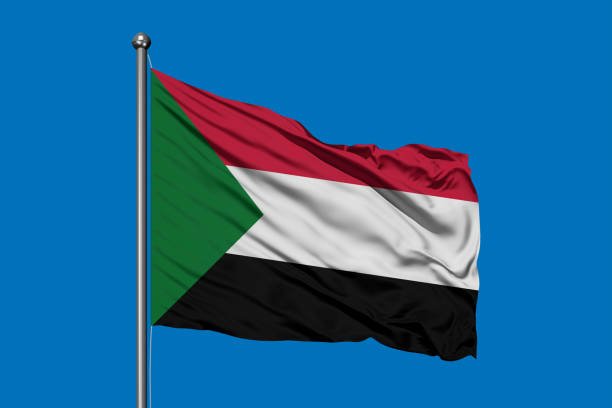
Aww, a Muslim posting an anti-Arab dog-whistle in support of Sudan, without naming the actual perpetrators (UAE or RSF)? 💔🥺 Sad, oh no, whatever will you do 💔🥺
It’s not okay.
I don’t excuse Arab supremacy either (f*ck you, Saudi royal), and it doesn’t mean we should leave our critical literacy behind or engage without an ounce of political awareness in our wording.
But remember this: moral posturing is empire’s favourite mask.
Here’s how to make it slip; use these steps in your reply to help lurkers decide and to train the algorithm
Challenge them to name the perpetrators of the genocide in Sudan.
Remind them what Israeli chants against Arabs in Palestine sound like (“the only good Arab is a 💀 Arab,” “💀 to the Arabs”), then confront them again to name the perpetrators (UAE, RSF).
If they pull identity politics on you to posture morality, remind them why Iblis was cast out of heaven; he was cast out for arrogance about his origin, which made him disobey Allah SWT’s order. Their use of “Muslim identity” plus other oppressed identities (if any) as a shield to absolve responsibility for holding complexities and integrity mirrors that.
If it’s still not working, congratulate them on falling for Dajjal — and block.
My code of conduct with people who posture morality is simple: if they tell you to jump, you ask, “how high?”
Again, moral posturing is empire’s favourite mask.
But then again, they’ll probably block you after number 3 anyway, like this girl did 👇🏻
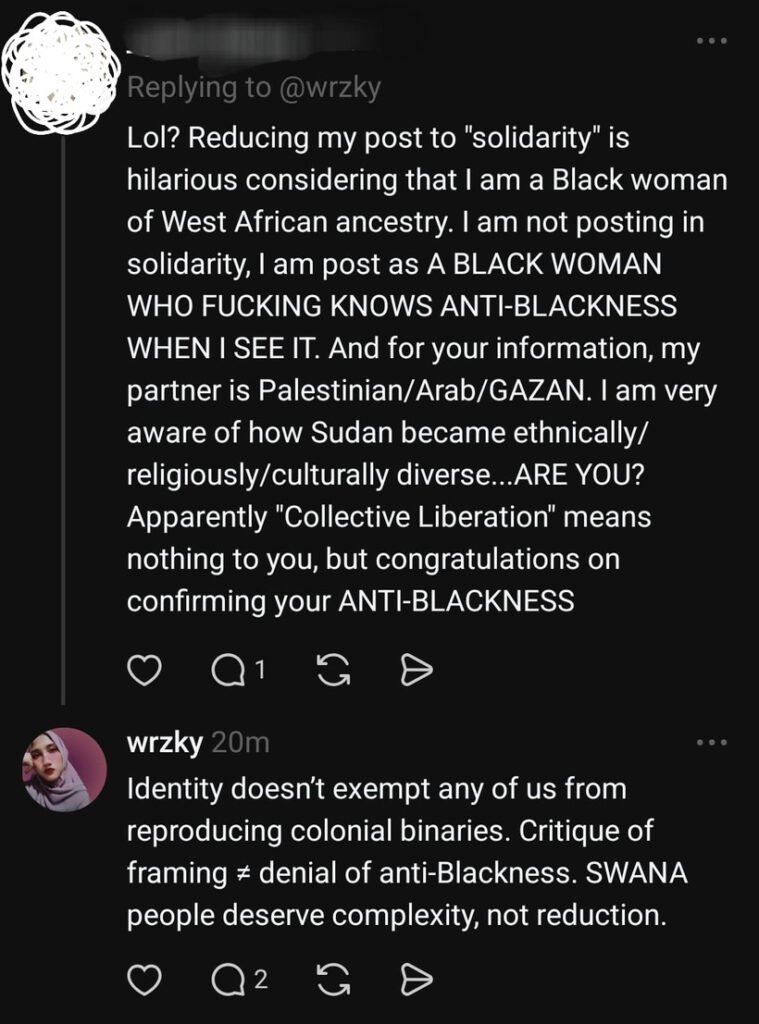
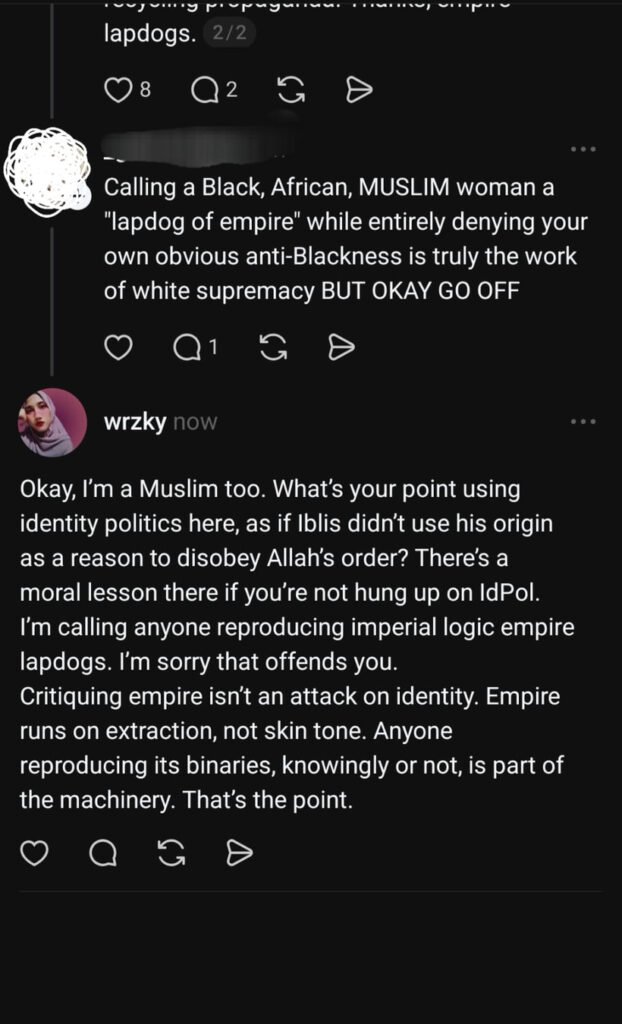
When the map you use for liberation is drawn by the empire, the destination is not freedom (wrzky, 2025)
No, but seriously, what’s funny about these accounts posting anti-Arab dog-whistles in support of Sudan while refusing to name the perpetrators (UAE, RSF) is that they use their Muslim identity as a shield, as if that means anything for us in Muslim-majority countries. If anything, they’re just giving us consent to escalate it into a haram police territory, a politically aware haram police territory.
Because that carries the same supremacist mentality as calling any condemnation of Zionism antisemitic, or calling any criticism of bigotry enacted by Black people anti-Blackness (this is in reference to the ongoing issues on Threads; it’s a shame really, I used to look up to a lot of them, but it is what it is).
This isn’t tone policing either. Tone policing is when someone tells you to istighfar after you say “death to IDF” or “the only good Nazi is a dead Nazi,” or just for swearing in general (the haram police have done this to me, jsyk, lmao).
So, if you’re a Muslim, maybe this is one of the amar makruf nahi munkar (enjoining good, forbidding evil) you can actually do quite easily.
If you’re a non-Muslim, I bet this would irate them more because gasps! — a non-Muslim reminds me about divine justice?! Lmao, that’d be funny.
•••
Some will inevitably bring up the Trans-Saharan trade as a “gotcha.” But that argument crumbles once you study it through both Islamic and materialist lenses (list of literary references below).
The Trans-Saharan slave trade wasn’t the same as the industrial chattel slavery that built European wealth.
As others have noted (1) (2), it carried over earlier servitude models from Rome and feudalism—more akin to bonded labour than to racialised caste. It existed before capitalism codified race as an economic hierarchy. Islam entered that world and re-humanised it: freeing enslaved people, outlawing interest, framing enslavement as a temporary social condition rather than a birthmark of inferiority.
The Trans-Atlantic trade, by contrast, was capitalism’s engine—mass-produced suffering for profit, transforming melanin into capital. That’s when Blackness and whiteness hardened into global categories.
So when people weaponise the Trans-Saharan trade to “prove” Arabs or Muslims invented anti-Blackness, they’re not being revolutionary, they’re reciting empire’s anthropology. Marxism explains the machinery; Islam explains the moral fracture. Both expose how colonial logic rewired history itself.
Hopefully all of this arms you to counter this narrative online or offline. I’m sorry I don’t have seven grand to pay you all for this counterpropaganda though.
Take care 💜
Please consider becoming a paid member starting from $6 a month.
Much love,
Wanda 💜
References
Aḥmad ibn Ḥanbal. (n.d.). Musnad Aḥmad ibn Ḥanbal [Hadith no. 23489]. Dar al-Kutub al-ʿIlmiyyah.
Al-Bukhārī, Muḥammad ibn Ismāʿīl. (n.d.). Ṣaḥīḥ al-Bukhārī (Book 55, Hadith 654). Dar al-Kutub al-ʿIlmiyyah.
Al-Qurʾān. (n.d.). Sūrat al-Ḥujurāt [49:13].
Ibn Saʿd, Muḥammad. (1990). Kitāb al-Ṭabaqāt al-Kabīr (Vol. 8, pp. 223–224). Dar Sādir.
Amin, S. (1989). Eurocentrism. Monthly Review Press.
Asad, T. (2003). Formations of the Secular: Christianity, Islam, Modernity. Stanford University Press.
Brown, J. A. C. (2019). Slavery and Islam. Oneworld Publications.
Césaire, A. (1955). Discourse on Colonialism. Monthly Review Press.
El Hamel, C. (2013). Black Morocco: A History of Slavery, Race, and Islam. Cambridge University Press.
Fanon, F. (1952). Black Skin, White Masks. Grove Press.
Fanon, F. (1961). The Wretched of the Earth. Grove Press.
Gordon, M. (1989). Slavery in the Arab World. New Amsterdam Books.
Hunwick, J., & Troutt Powell, E. ( Eds. ). (2002). The African Diaspora in the Mediterranean Lands of Islam. Markus Wiener Publishers.
Lewis, B. (1990). Race and Slavery in the Middle East: An Historical Enquiry. Oxford University Press.
Lovejoy, P. E. (2010). Transformations in Slavery: A History of Slavery in Africa (3rd ed.). Cambridge University Press.
Manning, P. (1990). Slavery and African Life: Occidental, Oriental, and African Slave Trades. Cambridge University Press.
Marmon, S. E. (Ed.). (1999). Slavery in the Islamic Middle East. Markus Wiener Publishers.
Robinson, C. J. (1983). Black Marxism: The Making of the Black Radical Tradition. University of North Carolina Press.
Rodney, W. (1972). How Europe Underdeveloped Africa. Howard University Press.
Said, E. W. (1978). Orientalism. Pantheon Books.
Segal, R. (2001). Islam’s Black Slaves: The Other Black Diaspora. Farrar, Straus and Giroux.
Williams, E. (1944). Capitalism and Slavery. University of North Carolina Press.